If your company sources parts or finished goods overseas, a weak dollar is more than an economic headline. It can directly increase your costs.
When the U.S. dollar loses strength, imported goods often become more expensive. That can put pressure on margins, shorten quote validity, and make pricing harder to predict — especially when tariffs, freight, and supplier costs are already moving targets.
In January 2026, the U.S. dollar hit a four-year low, prompting businesses to rethink pricing and sourcing.
Who “wins” and who “loses” when the dollar falls
In general, a weaker dollar makes imports more expensive and U.S. exports more attractive. If you manufacture overseas, the import side is the part you feel first.
Potential upsides
- Exporters get a pricing tailwind. If you sell abroad in foreign currency, your products may look cheaper to overseas customers.
- Multinationals may show stronger USD earnings. Foreign revenue translates into more dollars when converted back.
- Tourism can benefit. A weaker dollar can make the U.S. more affordable for foreign visitors
The downsides
- Higher landed costs and margin pressure. If you buy inputs priced in foreign currency (or in USD but influenced by global pricing), your costs can rise quickly.
- Inflation risk increases. A weaker dollar raises the price of imported goods, which can flow through supply chains.
- Quoting gets harder. If your quote window is 30–90 days, FX volatility can turn “accurate pricing” into a moving target, especially for components with thin margins
Currency Watch: CNY/USD
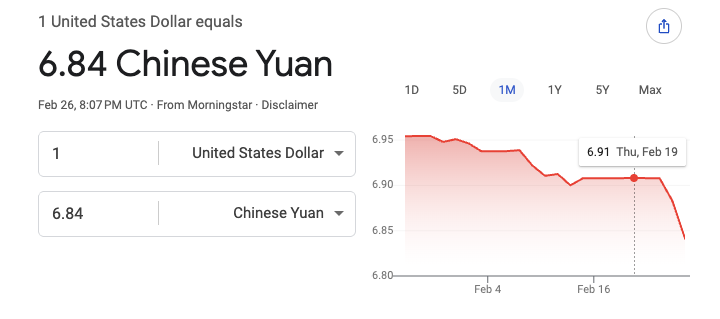
The Chinese yuan’s (CNY) exchange rate against the U.S. dollar (USD) significantly impacts global trade by influencing trade balances, export competitiveness, and the pace of de-dollarization. A stronger yuan makes Chinese exports more expensive, potentially narrowing its trade surplus, while increasing RMB usage in trade settlements reduces reliance on the USD.
Key Impacts of CNY/USD on Global Trade:
- Trade Balance & Competitiveness: As of early 2026, the yuan has seen appreciation pressure, with analysts forecasting it to reach around 6.91-6.92 to the dollar by late 2026. A stronger yuan decreases the cost of imports into China but reduces the competitiveness of Chinese exporters, which can lead to a shrinking trade surplus.
- De-dollarization and Currency Usage: China is actively promoting the internationalization of the renminbi (RMB). As of 2024, the RMB accounted for approximately 6% of global trade finance, with its role expanding through currency swap deals and increased usage in bilateral trade (e.g., Russia).
- Global Financial Markets: A rising yuan could attract capital into China and other Asian nations, potentially threatening the dollar’s status as a safe-haven asset, although the USD still dominates over 90% of global foreign exchange transactions.
- Economic Policies and Trade Relations: The People’s Bank of China (PBOC) manages the yuan to maintain stability, but a significant appreciation (e.g., beyond 10%) could affect China’s domestic economy, exacerbating deflationary pressures.
- Impact on Other Countries: A stronger yuan can benefit countries that export raw materials to China. Conversely, nations that compete with China in manufacturing may benefit from higher Chinese prices, while the US might see some relief in its trade deficit, though it could affect global supply chains.
While the yuan is gaining prominence in trade, it is unlikely to displace the dollar as the primary global reserve currency in the near future, as the dollar still dominates over 80% of global trade finance.
FAQs
Does a weak dollar increase import costs?
Yes, a weak dollar can increase import costs for U.S. companies. When the dollar loses value, overseas goods and components often become more expensive in dollar terms, raising total landed costs.
How does a weak dollar affect overseas manufacturing quotes?
A weak dollar can make quotes less predictable. If supplier pricing, raw materials, freight, or related costs shift during the quoting window, buyers may face higher costs before production even begins.
Why does currency volatility matter for U.S. manufacturers?
Currency volatility matters because it can reduce margin, shorten quote validity, and create pricing uncertainty between the time a quote is issued and the time an order is placed.
What can buyers do to reduce exchange-rate risk?
Buyers can reduce exchange-rate risk by working from detailed quotes, carefully reviewing quote timing, clarifying what is included, and planning for potential cost changes before approving production.
Can a weak dollar affect more than just the invoice price?
Yes. A weak dollar can affect overall sourcing costs, including quote accuracy, margin protection, budgeting, and long-term planning for overseas production.
How can ITI Manufacturing help?
ITI Manufacturing helps reduce uncertainty through its Quotations with Confidence process, which gives customers clearer assumptions, better visibility into costs, and fewer surprises between quote approval and production.
Bottom Line
A weak dollar can make overseas manufacturing more expensive for U.S. companies. It can raise landed costs, increase quote volatility, and make already-thin margins even harder to protect.
That is why strong sourcing decisions start with strong quoting.
At ITI Manufacturing, our Quotations with Confidence process is designed to help U.S. companies move forward with better visibility, stronger documentation, and fewer surprises between quote and production.
Need a quote you can stand behind? Start with ITI Manufacturing.